The Politics of Fury

Shirin Neshat Flavia #2, from The Fury (2023)
Photography ©Shirin Neshat/Goodman Gallery
Upstairs at the Goodman Gallery in Mayfair, London hang large-scale black-and-white photographs of women. Look closer at their naked bodies, parts of which are symbolically covered, and these women of various ages and ethnicities bear signs of abuse and mutilation. Meanwhile, downstairs in the gallery, the video installation tells the stylised, fictional story of a woman struggling with her memories of imprisonment and sexual violence.
The Fury is the latest body of work by the New York-based Iranian visual artist Shirin Neshat, who, since the 1990s, has captivated viewers — and in some instances caused controversy — through an art that investigates gender and society, time and memory, the individual and the collective, and the complexities and contradictions of Islam, told through a personal and diasporic lens.
Neshat’s mesmerising, cinematic, large-scale black-and-white photography is overlaid with handwritten Farsi calligraphy — poetry, prose — inviting the viewer to read more than the surface image. Likewise, with her feature films and film installations, she has created her own unique moving image language.
In her most political work, Women of Allah (1994/1997), the artist directly uses the veil symbol to capture the paradox of conviction, submission and violence. Neshat has also directed three feature films, including Women Without Men (2009), winner of the Silver Lion Award for best director at the Venice International Film Festival.
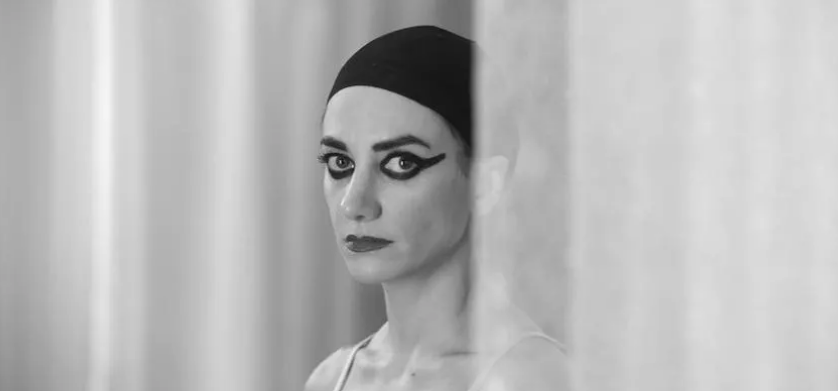
Still from Shirin Neshat’s The Fury
Photography ©Shirin Neshat/Goodman Gallery
The Fury was shot in June 2022 near Neshat’s Brooklyn studio in New York. In the film, the female protagonist is played by Iranian-American actor Sheila Vand, while the remaining cast are Neshat’s co-students from her African dance class. In the film, dance expresses liberation. It is fundamental to the storytelling. Choreographed by Neshat’s teacher, the climax scene is a stirring ritual of movement expressing protest and rage, performed to the haunting vocals of Tunisian musician Emel Mathlouthi, singing Soltane Ghalbha (King of Hearts, a heartfelt Iranian love song from 1968), the melody slowed down, and the lyrics retold in Arabic.
I caught up with Neshat to see why she has created work of such political urgency now, and what she hopes the viewer will take from this body of work.
The Fury is raw; it is full of rage and a sense of urgency at a time when the whole world is wrapped in war, hatred, tribalism. The film is difficult to watch, and I found myself walking away at first only to return and stay despite my agitation and uncomfortableness.
Yes, art should be this way. It shouldn’t be lazy participation. A really good work of art or film stays with you. For me, it is how to penetrate the audience.
That certainly is the case with The Fury, and it’s fair to say this is your most radical work in recent times. Has it been a conscious move to revisit the more overtly political and, at the same time, personal conversation that began with Women of Allah?
After Women of Allah, I decided I wasn’t going to make any work that is so politically pointed because there were judgments coming from all directions — from the government in Iran, from Iranian diaspora and Iranian artists — and I moved on to making work that remained politically charged but softer. So yes, I think it would be fair to say that The Fury is one of my most political works; punchy with what it’s trying to say.
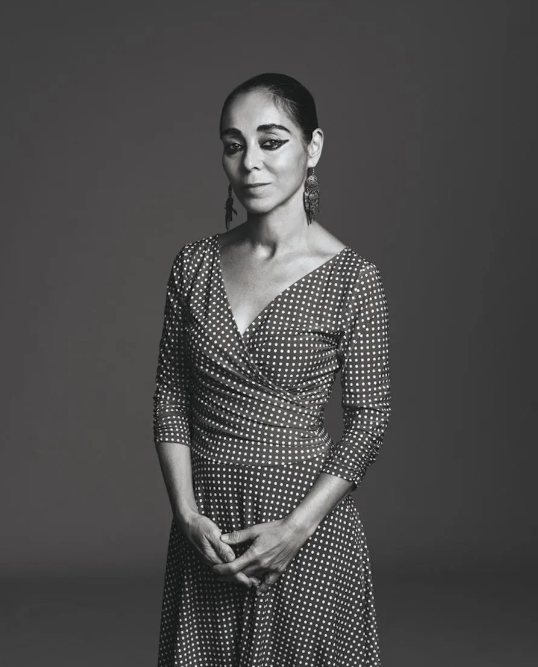
Artist and filmmaker, Shirin Neshat
Photography ©Rodolfo Martinez
Am I correct in sensing the conscious New York staging, casting of local actors, and the music speaks of its international charge — that you are speaking out against violence on women everywhere, on the absurdity of war, on intolerance, and tyranny in its broader universal context?
Yes, this is not just about Iran, even if it may appear to be so on the surface. It is about any woman who goes under sexual exploitation by the people in power. The point of view is different from when I made Women of Allah. Then, my work was about having a nostalgic view of Iran, where I haven’t been in a long time, of trying to understand the concept of shaha-dat (martyrdom). The Fury is taking it in a different place, where I’m putting a lot more of me in it: my community, my neighbourhood, an Iranian woman outside of her country but still haunted by the dark past.
You’ve worked with both feature films and film installations. Can you explain your approach to the latter?
When making a film for a gallery or a museum, you can create an atmosphere or an experience where you force the audience to participate in the work. Whereas in the cinema, the audience will usually sit back as the story unfolds, in a gallery setting, the film is much more about how you tell the story and how physical and sculptural you make it.
In The Fury you tease this with the constant tension between the screens, an ongoing discourse, each offering a different viewpoint. Is this fundamental to how you want the audience to see the work?
I never use multiple channel projections as a spectacle; there is always an intention narratively. In the film, we see her point-of-view, the way she views the world, which is often negative. We also see the male gaze on her and how she appears to them. Then, we see the people on the streets and their view of her.
The film shows various perspectives and points of view, asking the viewer to be the editor. This is both challenging and offers great freedom to create a sense of enigma: the audience needs to work harder to see what they’re looking at.

Shirin Neshat Daniela #2, from The Fury series, 2023
Photography ©Shirin Neshat/Goodman Gallery
In the film you reference two classics of European post-war cinema: Pasolini’s Saló and Liliana Cavani’s The Night Porter. Pasolini is looking to how absolute power (in this case Italy’s Mussolini) seeks to destroy not just bodies but the very possibility of human dignity. While Cavani’s film is a deeply disturbing story of a Nazi concentration camp survivor's relationship with her former SS officer who is now working as a night porter at a Vienna hotel — a character that feels directly referenced in The Fury.
Yes, in The Night Porter, Charlotte Rampling falls in love with her interrogator in what’s known as Stockholm syndrome — the control of the person who captures versus the captured. In The Fury, when she dances in front of the officers, is it something she had to do for the price of freedom, or maybe she is imagining it — who knows… It is about the idea of an illegitimate relationship between a person of power and the powerless that becomes highly sexualised yet controlled. This could be a possibility for any woman whose body becomes an object of desire but also an object of violence. For me, it was a question of who controls whom, who controls the gaze, and who holds the power.
The other thing is that there is a very strong sense of brutality when it comes with men in uniform and a naked body. It says everything about the power dynamic. That image to me was very powerful in The Night Porter.
There is a powerful play of image and sound in your film, too, and I’m interested in understanding your process of choosing the music.
I chose Emel Mathlouthi’s Soltane Ghalbha, which she had rewritten in Arabic as Holm, because the nature of the language made it not entirely Iranian, and because it has the perfect melancholic sound. For the film, Emel sang the song at a slow pace to fit our rhythm. I think the result is magical.
I agree. The final scene, in which the public joins the protagonist in a solidarity dance, shows the power of collective action. It is a joyful note to end the darkness. Do you feel living in New York, your diasporic experience, has helped shape this take on the world?
In The Fury, the bystanders become those who express solidarity despite not knowing who she is — purely through human connection and bonding. There is something positive about being in survival mode, being able to live somewhere where the whole world becomes your community. You learn to find and form communities that give you love and compassion.
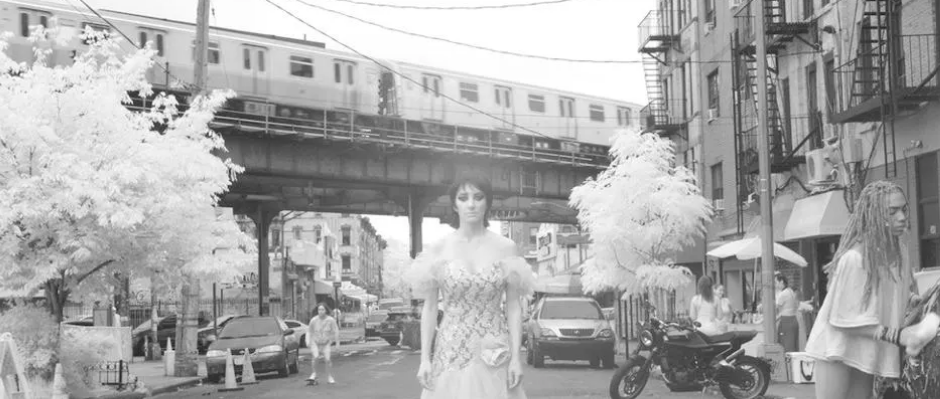
Still from The Fury by Shirin Neshat, filmed in Brooklyn (2022)
Photography ©Shirin Neshat/Goodman Gallery
In that sense, the film feels deeply autobiographical.
Yes, it is also an expression of my life. I live in Brooklyn surrounded by people from all over the world — many are working class, and many don’t speak English. But they are the closest people to me, and if something should happen, they would rescue me. There is something powerful in that we have been given this gift of broadening our horizons, learning that humanity exists everywhere.
How do you hope the audience to read The Fury?
Because the work is so much about emotions, the intention is to move people, to provoke people. So, by situating them in a space that is agitating, uncomfortable even, you give them no option but to make a choice. Some people will walk out, but many will stay. It depends on how interested they are as the film demands a lot, asking your imagination to work hard: is this an illusion of reality? Are we inside or outside? I see it like poetry, whereby nothing really makes sense, but there are all these references to reality — like a dream.
What does art and being an artist mean to you?
That’s a good question. When I first started out as an artist, I didn’t think about the audience so much. Tarkovsky (director Andrei Tarkovsky) once said art is something you become a servant of, that you don’t seek it; it is an urgency. And I think for me, life is pretty much meaningless unless I do my work. To me, it is a way of life, but it is wonderful to be able to share it with other people. I put a lot of myself, my own insecurities, fears, vulnerabilities and emotions in my work, and it feels good; it feels meaningful. With The Fury, I’m not dictating anything. I would like the audience not to make fixed statements, and I want to attract them emotionally. I want to move them.
Shirin Neshat, The Fury, Goodman Gallery London, 7 October to 4 November 2023, and screened at London Film Festival 2023.
This interview was first published in Forbes.