The Systematic Eye
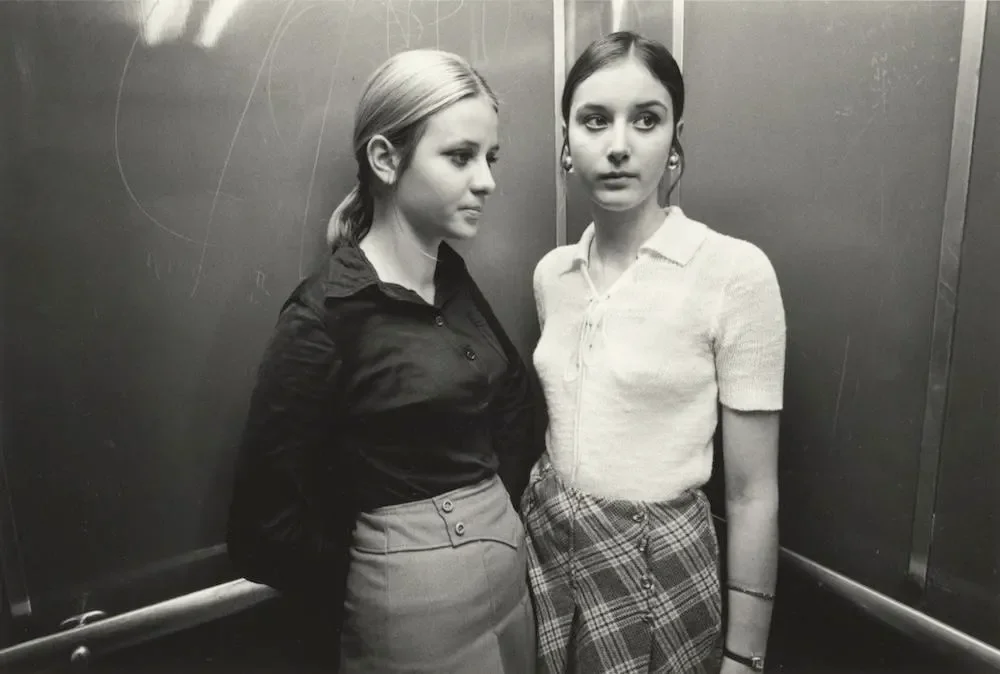
Heinrich Riebesehl, Menschen Im Fahrstuhl (1969), Berlin. Photography ©Heinrich Riebesehl
We live in an age defined so much by image-making. We, even the least of us digital natives, communicate through image, real or constructed, and are documented constantly—too often without our knowledge or consent. Which makes the latest exhibition at Milan’s Fondazione Prada all the more poignant. Typologien: Photography in 20th-Century Germany is a fascinating exploration of the photograph and place, of image-making as both historical record and social commentary. Focusing on 25 diverse photographers working throughout the 20th century in Germany, Typologien examines how photography has been used to express collective, social, political and personal ideas.
Opened in 2015 (the Torre building joined in 2018), Fondazione Prada functions as the fashion house’s cultural hub. The design, by Rotterdam-based Office for Metropolitan Architecture (OMA) and led by the maverick architect Rem Koolhaas, is pretty spectacular. Built on the site of a former early 20th-century gin distillery in Largo Isarco, an industrial area in Milan, the buildings blend old and new, industry and art, for a complex and dynamic space that brilliantly communicates its place as a platform for open discourse on arts and ideas. (As a side note, for anyone interested in culture, a trip to Milan should include a visit to Fondazione Prada.)
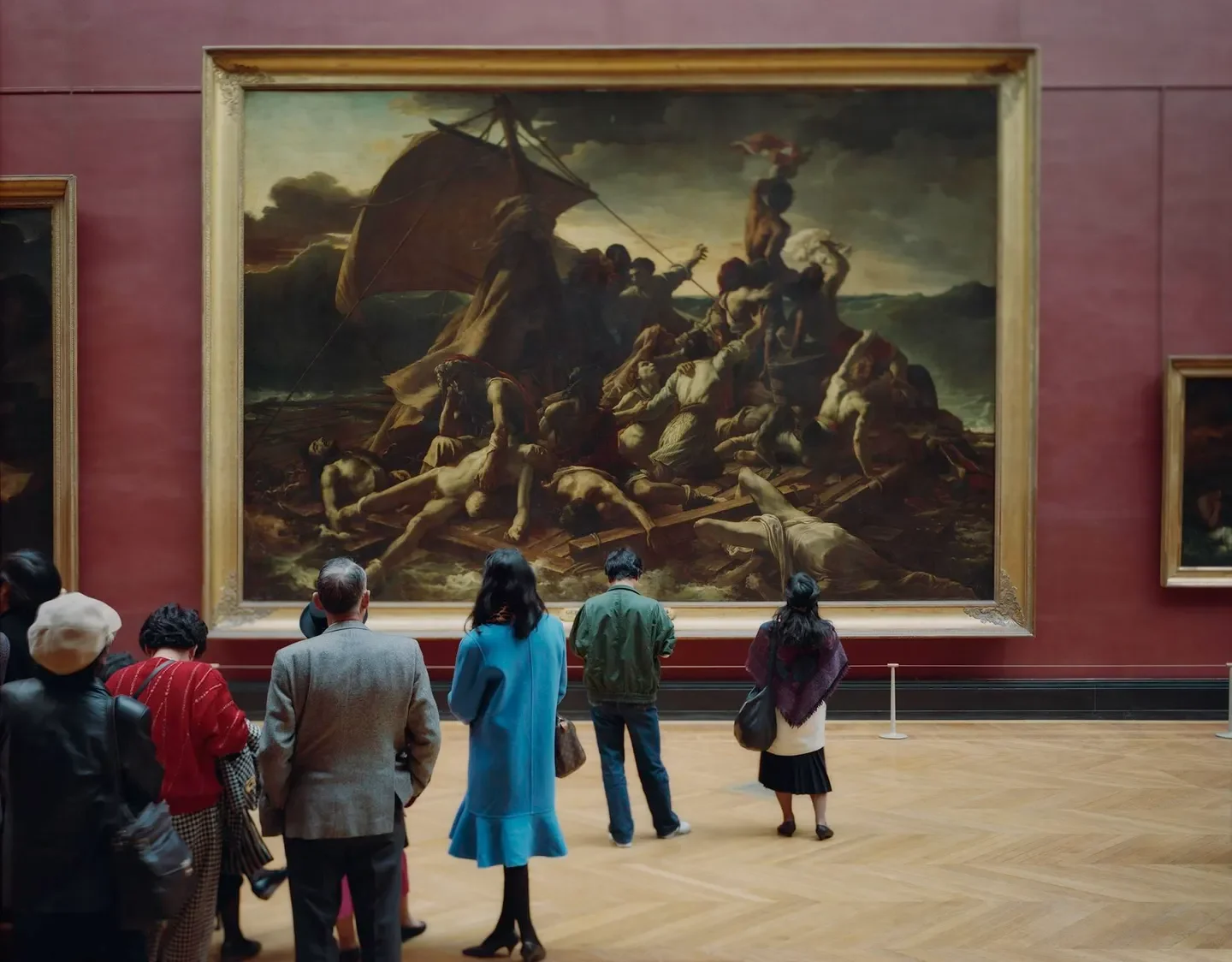
Thomas Struth, Musée du Louvre IV, Paris (1989). Photography ©Thomas Struth/ZKM
The 600-plus images on show at Typologien are organised typologically rather than chronologically, with the curatorial direction inviting us to view this turbulent time in Germany’s history — and the role and scope of photography — through multiple lenses. Though varied in approach, the works on show here are united by a shared intent: to classify, to order, to make sense of the world through image. The architecture certainly adds another layer of intrigue. These are clear, quiet spaces, a system of suspended walls offering geometric partitions to instigate unexpected dialogues between artists and artistic practices, and time.
The idea of “typology”, a system first used in 17th and 18th-century botany to classify and study plants, found its way into German photography in the early part of the last century. And while typology is by nature a rigid, formal framework, it has somewhat allowed for surprising connections between German artists across generations, and through to the digital age.
The exhibition opens with Karl Blossfeldt (1865–1932), one of the first artists to adapt the classification system used in botanical studies to photography. His detailed plant atlas also represented a clear moment for “New Objectivity,” the movement born during the Weimar Republic to promote clarity and documentation of realism, with photography seen as a medium to explore the very idea of typology.
Particularly intriguing is the space dedicated to August Sander (1876–1964). The photographer made a portrait of society through its people with his utterly brilliant “People of the 20th Century” project grouping individuals— from farmers to bakers, artisans to artists, and the bourgeoisie—into social types. It’s an incredible document on class and identity in Germany between the wars, capturing the brief (though culturally and politically significant) moment that was the Weimar Republic. Sander’s portraits inspired generations of photographers, including the influential duo Bernd and Hilla Becher and their Düsseldorf School successors.
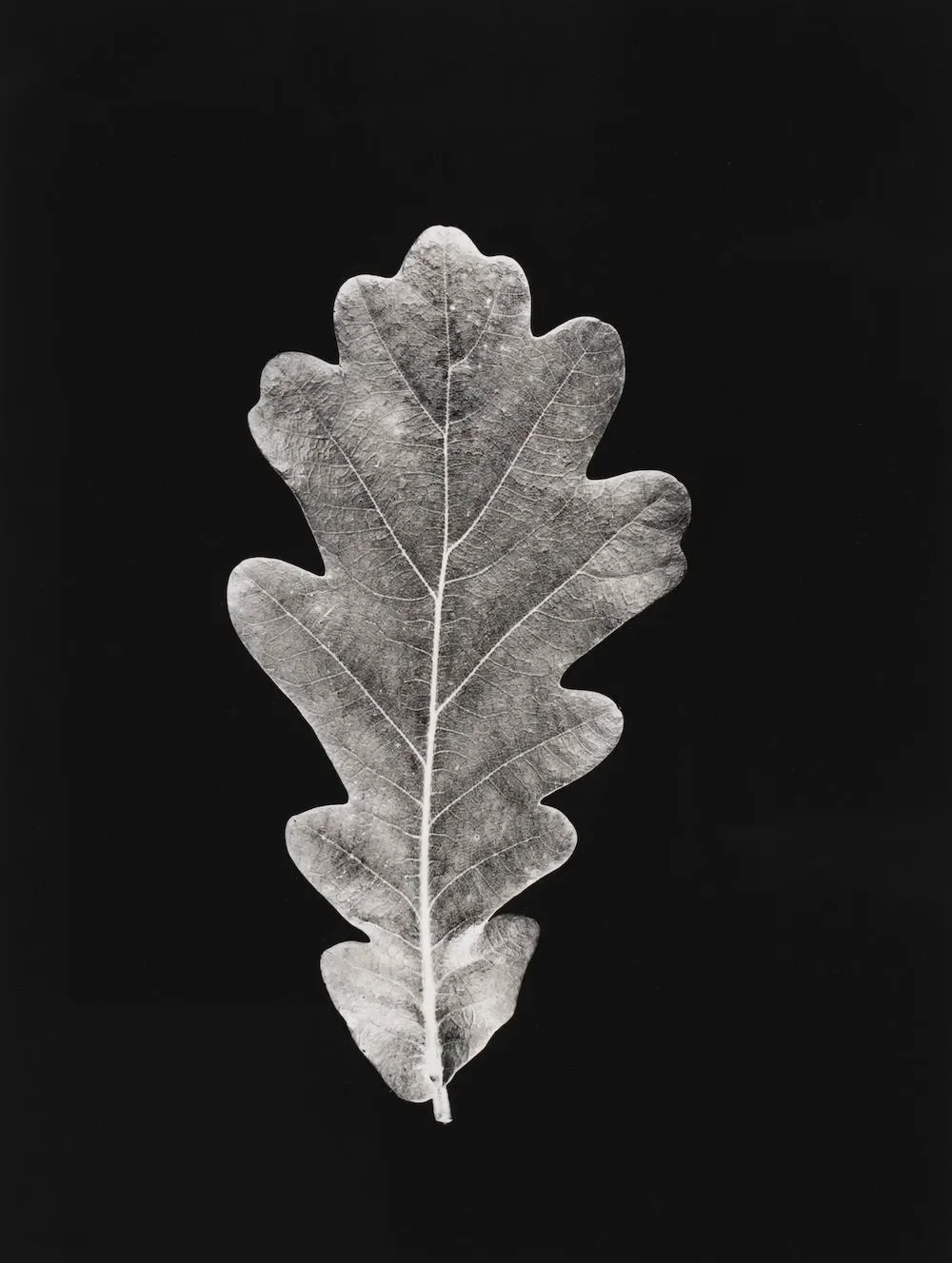
Hilla Becher, Studie eines Eichenblatts (1965). Photography ©Estate Bernd & Hilla Becher/Max Becher/Die Photographische Sammlung/SK Stiftung Kultur
Elsewhere, we encounter Hans-Peter Feldmann (1941–2023), who caught on camera everyday objects and historical events with a strange mix of humour and systematic cataloguing and documentation. In his series, he invented personal yet very political typologies and adopted a deliberate snapshot approach with a commercial aesthetic.
In the 1970s and 1980s, in dialogue with their mentors Bernd and Hilla Becher, artists like Andreas Gursky gradually moved away from black-and-white purism, embracing color and exploring banal themes through portraits, cityscapes and cultural landmarks. Around the same time, Isa Genzken engaged directly with photography, subverting the traditional portrait by focusing instead on physiognomic detail to examine individuality and typological categorisation.
In another space, Gerhard Richter’s Atlas (1962–present) unfolds as a sprawling so-called private album, composed of found imagery — snapshots, pornographic material, press clippings, historical photographs. Among them: stark documentation of Nazi concentration camps, the Red Army Faction, and German reunification. Richter seems to reject the notion of typology altogether, pushing instead the idea of visual equivalence to its limits, exposing how images (regardless of weight or meaning) can be trivialized through repetition. The result is a deeper awareness of a suppressed collective memory — a concept central to the artist’s work.
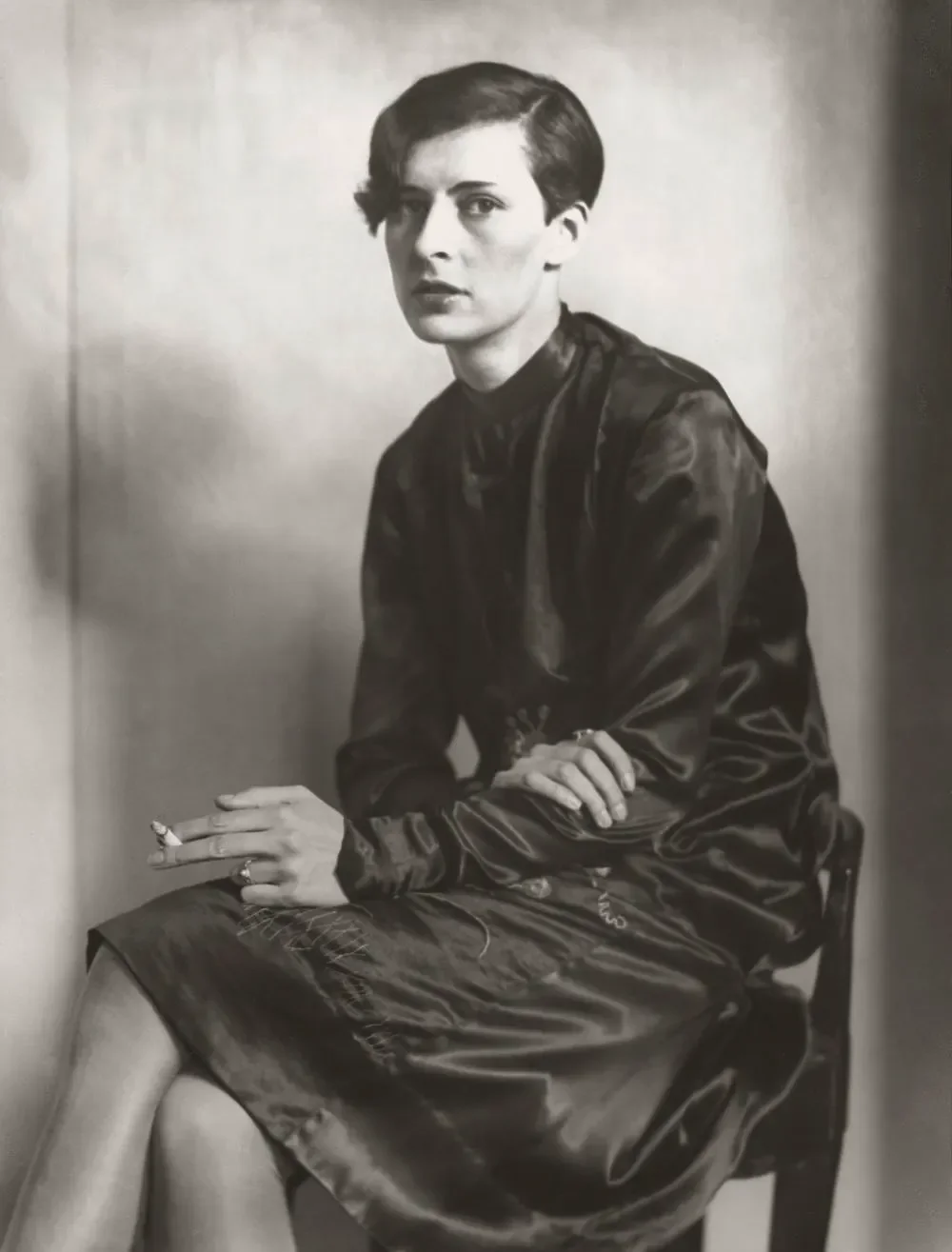
August Sander, Sekretärin beim Westdeutschen Rundfunk in Köln (1931). Photography ©Die Photographische Sammlung/SK Stiftung Kultur/August Sander Archive
“Only through juxtaposition and direct comparison is it possible to find out what is individual and what is universal, what is normative or real,” explains curator Susanne Pfeffer, art historian and director of Museum MMK für Moderne Kunst in Frankfurt. “The typological comparison allows differences and similarities to emerge and the specifics to be grasped. Unknown or previously unperceived things about nature, the animal, or the object, about place and time become visible and recognisable.”
Pfeffer speaks of how the unique and the individual are being absorbed into a global mass. “The internet allows typologies to be created in a matter of seconds. And yet this is precisely when it seems important — to artists — to take a closer look. When the present seems to have abandoned the future, we need to observe the past more closely. When everything seems to be shouting at you and becoming increasingly brutal, it is important to take a quiet pause and use the silence to see and think clearly. When differences are not seen as something other, but turned into something that divides us, it is crucial to notice what we have in common. Typologies allow us to identify remarkable similarities and subtle differences.”
Typologien: Photography in 20th-Century Germany was at Fondazione Prada in Milan from April 3 to July 14, 2025.
This article was first published in Forbes