Art Beneath the Bubbles

Julian Charrière's Chorals (2025) at Ruinart. Photography ©Chloe LeReste
Some forty metres beneath Reims, deep in the dark, damp UNESCO-protected chalk cellars in former Gallo-Roman quarries, Maison Ruinart has been installing contemporary art. One lane leads to Julian Charrière's Chorals — an installation of sound, light, water, teasing a dialogue between the geological memory of these crayères and today's oceans in flux. Here, the underwater sounds recorded from marine ecosystems evoke the sea that once covered this land.
Down another crayère lane and we encounter Retour aux Sources by artist duo Mouawad Laurier, a permanent installation also in conversation with our fragile earth. This is an AI-powered sculpture that responds to real-time data from the weather and the vineyards above grounds, measuring temperature, wind, vine cycle and fermentation stages to be a living installation that responds to the seasons and evolves with our changing climate.
We’re here in the heart of Reims to research a book on champagne through a cultural lens: as art, literature, social ritual and symbol. And all those levels down, immersed in so much history (if only walls could talk) is a truly special experience. These are conceptual artworks that are so visceral, but more importantly they raise valid questions and concerns around the fragility of our planet, our relation to nature, the very nature above these crayères which has, for hundreds of years, cultivated the fruit that gives this region of France its unique, special wine: champagne.
Julian Charrière and Mouawad Laurier’s installations join a host of other artists – Tomás Saraceno, NILS-UDO, Eva Jospin – as part of ten artworks commissioned by Ruinart in the countdown to the grand marque’s 300th anniversary in 2029. What they share is their enquiry into ecology, climate uncertainty and the role it will play in the future of viticulture in historic wine regions like Champagne.
The sustainability angle is no coincidence. Like many champagne houses we encounter in our research, Ruinart is increasingly committed to embedding an ecological ethos within the company from vineyard work, to transportation and packaging. “What we do is a collaboration between humanity and nature. You need to respect nature because if you don’t, in the end it will not give you the grapes you need,” Fabien Vallerian, international director of arts and culture at Ruinart, tells me when we catch up on my return to London. This, naturally, directs his arts programme.
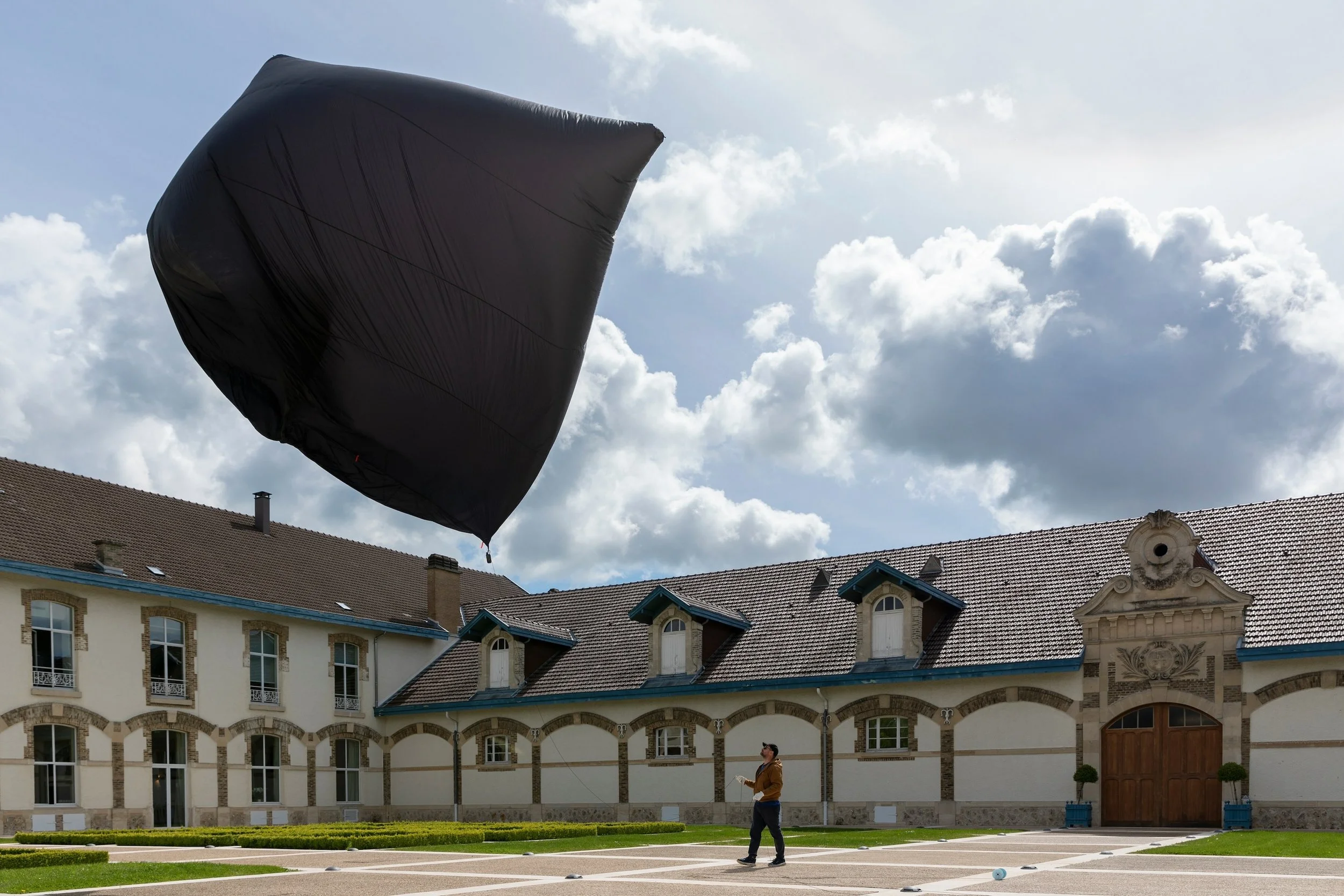
Tomás Saraceno's Movement for Ruinart (2021) addresses the climate emergency. Photography ©Dario Lagana
“We are not into using art as décor to showcase the brand,” he insists. “We use our art programme to give artists a platform, to share their voice, to talk about the contemporary world. When you are the oldest champagne company, you also need to bring new things into the DNA to enrich it, to bring that liveliness of looking forward.” Vallerian says they often have a preconceived idea of what a project may be on commission yet are almost always surprised by how the artists respond to the theme and to the house. “They never seem to go in the direction that we thought would be natural for them,” he smiles, “which is why artists are special.”
Elsewhere, beneath Champagne’s other capital, Épernay, in crayères that once sheltered the French Resistance as secret channels for spreading news to Allied forces (there are markings and codes scribbled throughout these cellars… but that’s another story reserved for the book), another historic house, Perrier-Jouët, has responded to nature not directly from today’s perspective but through the lens of Art Nouveau, and its core philosophy of capturing the vitality and organic logic of the natural world.
Installed in 2012 as a permanent installation, Lost Time by studio Glithero references the architect Antoni Gaudí’s method of suspending weighted chains to generate organic curves employed for his Sagrada Familia in Barcelona. The studio has distilled the feeling of Gaudí’s final masterpiece: the stillness of these chalk cellars against an ephemeral dance of bubbles, where puddles mirror vaulted ceilings and dewdrops glisten in forgotten cobwebs, for what feels like suspended time in this humid underground darkness. Sarah van Gameren of studio Glithero speaks of the work’s direct response to Art Nouveau, noting, “we have shifted the emphasis from the figurative representation of nature, to the capturing of a pure experience of nature.”
The art of storytelling
Champagne houses, these grandes marques that have reigned the region for hundreds of years and brought this sparkling wine to the attention of the world, have always been cultural commissioners. They understood the power of the arts in shaping cultural legacy. Think of Czech artist Alphonse Mucha’s artwork in the 19th century for first Ruinart and then the many memorable poster, catalogues and menu designs for Moët & Chandon, all of which are true to the Belle Époque tradition of artist-designed labels and lithographs.
Meanwhile, initiated in 1983, the longest-running continuous arts collaboration is Taittinger's Collection Programme, which is more of a rotating gallery-of-sorts with the bottle as canvas. A favourite has to be the Robert Rauschenberg collaboration for the Brut Millésimé 2000 vintage released in 2007, a year before the artist’s death, and featuring a rooster as a symbol of dawn atop a church tower.

at Maison Belle Epoque, Henri de Toulouse-Lautrec ceramic plaque of Yvette Guilbert (1895). Photography ©Perrier-Jouët
Perhaps what is different now in these artist engagements is the question and the ambition with some collaborations, at least with some of the more adventurous bigger houses. They are not always seeing art as a way of making champagne look better, but rather what can artists reveal about champagne that we may have overlooked or forgotten, and what can art say about the future of champagne which, unlike any other wine, is built on storytelling.
Take Perrier-Jouët whose identity, as mentioned earlier, is interwoven with French Art Nouveau. In 1902, Charles Perrier (the son of the co-founder who ran the house until 1878) asked artist and scientist Émile Gallé to create a Japanese white anemone motif, daughter of the wind, as a metaphor for anticipation: flowers that close at night and reopen each morning, their delicate petals blown open by the breeze. The collaboration proved to be fantastic marketing, of course, with bottle designs that remain so recognisable to this day, but it was arguably philosophy made visible. Perrier wanted to capture the florality he cultivated and the Chardonnay elegance he had developed. And the anemone bottle became the answer with Art Nouveau’s floral lines mirroring the wine’s character.
Maison Belle Époque, the private house which accommodates Perrier-Jouët's special guests, is home to Europe’s largest private collection of French Art Nouveau. It’s a true treasure trove of art, furniture and objets d’art of the period, with over 200 commissioned works by Émile Gallé, Hector Guimard, Louis Majorelle and Auguste and Antonin Daum. It’s a total treat walking through the house, seeing work by such visionaries of the time including a fabulous ceramic plaque by Henri de Toulouse-Lautrec of Yvette Guilbert, inscribed by the famed cabaret singer and muse of the artist, and Auguste Rodin’s L'Eternel Printemps, a small bronze of lovers entwined.
There are other artistic happenings across the maisons. At Krug in Reims music is the chosen cultural expression. It’s a custom that goes back as far as the 1920s when the house ran a salon de musique, a dedicated music room next to the cellar where family and friends played instruments. Today, sixth-generation heir Olivier Krug personally leads the dynamic musical collaborations that have included the late Ryuichi Sakamoto, who in 2022 created Suite for Krug in 2008 — a three-movement symphony that premiered at Brooklyn Museum that year.
The latest work, Every Note Counts, is with the celebrated British composer Max Richter who is writing three pieces inspired by marque’s 2008 cuvées: Clarity for Krug Clos d’Ambonnay 2008, Ensemble for Krug 2008 vintage, and Sinfonia for Krug Grande Cuvée 164ème Édition, which blends 127 wines from 11 years. What makes the collaboration all the more thrilling is the timing with Richter working alongside Krug’s cellar master Julie Cavil as the champagnes develop. Released in February 2026, Every Note Counts promises to be a composition that reflects what the composer calls the champagne’s emotional architecture.
Richter explained his creative expression in an interview with Schön! Magazine: “The way light reflects through the glass, the texture, the temperature, the scent, and even the sound. That is what I would call the emotional architecture. Champagne is tied to special moments, to marking time in meaningful ways, and above all to joy.”
Joie de vivre
As with champagne styles, it’s fair to say each house has its own artistic expression. Dom Pérignon, for instance, tends to work with big, bold names across fashion and entertainment, which to my mind works well for a marque so grandly rooted in the story of champagne. Recent collaborations with Takashi Murakami, the estate of Jean-Michel Basquiat, Lady Gaga, Zoë Kravitz and Tilda Swinton continue a legacy of partnerships since 2005 with the likes of Andy Warhol, Jeff Koons and David Lynch.
For Veuve Clicquot, on the other hand, contemporary artistic expressions are more rooted in lifestyle, connecting champagne to broader cultural conversations. Last year the house collaborated with French artist-designer Simon Porte Jacquemus for La Grande Dame 2018, timed to launch during September’s New York Fashion Week. The design is light and elegant, echoing the brand but also the eternal sunshine spirit of champagne, with bottles wrapped in white linen embroidered with yellow calligraphy, referencing an old Italian cooling method.
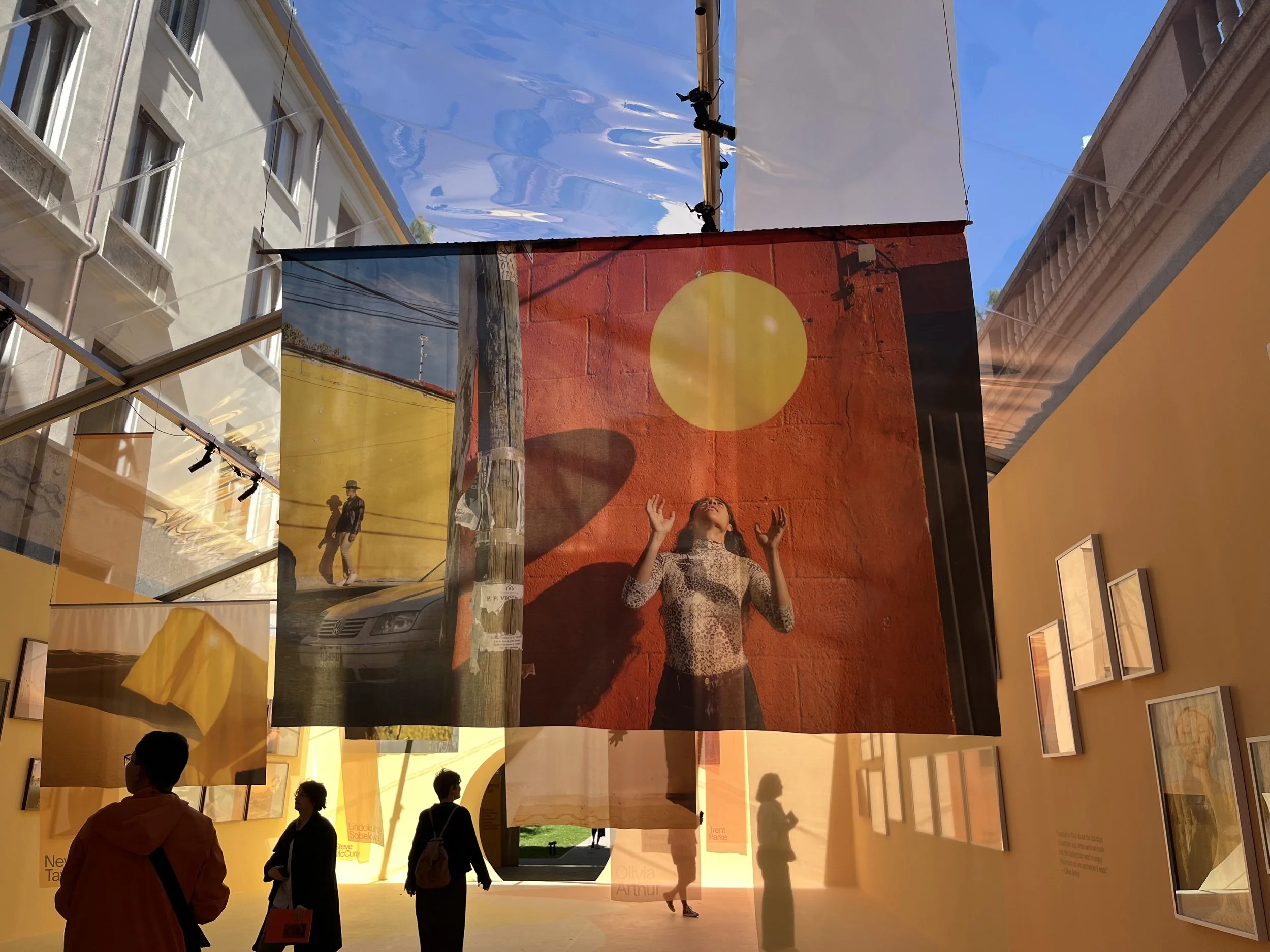
Emotions of the Sun (2024, Milan Design Week) where Veuve Clicquot commissioned eight Magnum photographers across five continents to interpret the sun as metaphor for their Yellow Label cuvée. Photography ©Nargess Banks
Perhaps more ambitious has been the Solaire campaign to mark the maison’s 250th birthday in 2022 – the sun a homage to its founder, Madame Clicquot, and her belief that champagne represents optimism, hope, possibilities. Most notable was the travelling group exhibition, Emotions of the Sun, initially shown during Milan Design Week 2024. Veuve Clicquot challenged eight Magnum photographers – all women of various career stages across five continents – to interpret the sun as an expression of the house’s classic Yellow Label cuvée. The result is a fascinating study of what the marque’s yellow means beyond brand identity, and what it signifies globally. The photographs were displayed within a space designed to evoke the sun, travelling from Milan’s Giardino Senato, where I first caught sight of it, to New York and Cape Town.
What remains
There is so much more art to speak of which we’ll save for the book. Yet travelling between Ruinart’s historical crayères, Perrier-Jouët's Belle Époque splendour, Krug’s sonic experiments, Veuve Clicquot’s joie de vivre, a pattern emerges: the arts here symbolise the urge to push towards the future; it’s an outward expression of a growing movement towards nature-conscious, terroir-focused champagne that reaches beyond the commercial. These are exciting times for a region, and a brand so steeped in history.
Champagne, as a place, has always been at the crossroads; it has always been looking beyond its borders. So many have come to this land, conquered, stayed, left. It’s a region connected to the world and thus naturally progressive. And it is in this spirit that the grandes marques and grower houses are continuing a conversation that started 300 years ago about what it means to turn time, earth and craft into something beyond the moment of consumption.
Nick Pegna, Sotheby’s global head of wine and spirits, summed it up well when he told me: “Champagne sits in people’s imagination in a different position to other fine wines. There’s no other wine region that manages to do it quite so well.”
Perhaps that’s because champagne has always understood something fundamental: that luxury isn’t only about what’s rare or expensive, but about what endures. Walking through these houses — some family-run for generations, others now part of global empires — what strikes you isn’t so much the opulence (and yes there is plenty); it’s the humility beneath it. The cellar masters who speak about their vines and wines with quiet reverence. The archivists who preserve centuries-old notebooks. The way a priceless Art Nouveau collection sits casually in a guest bedroom, not behind glass. The conceptual art that happily lives in ancient chalk quarries.
Here, in the cool darkness of the crayères, time moves differently. The future is being laid down in bottles that won’t be opened for decades, while above ground, contemporary artists reimagine what champagne might mean to generations yet to come. It’s a place that holds its history lightly, never forgetting, but never bound. This is the story we tell in The Life Champagne.
The Life Champagne will be published in summer 2026.