The Joy of Making
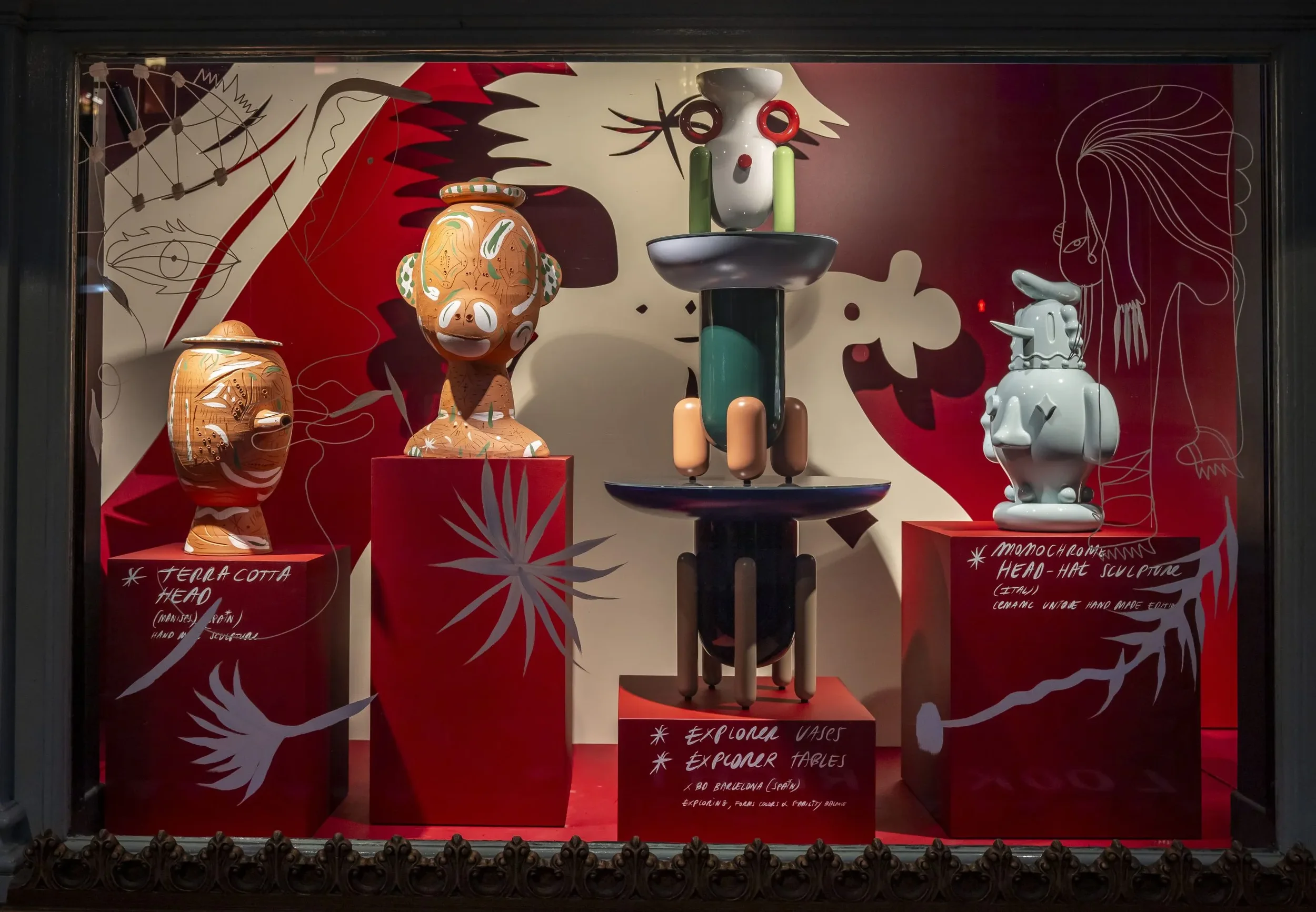
Jaime Hayon's Fortnum & Mason installation during London Design Festival. Photography ©Jeff Moor/Jaime Hayon
Jaime Hayon has a unique voice. Born in Madrid and based in Valencia, he skilfully straddles the realms of art, design and craft, weaving his imaginative flair into every piece. His creations are unmistakably his own – reflecting a specific time and place, yet always recognisably from the Hayon Studio. With bold forms, vibrant colours and a touch of humour, he has captivated audiences worldwide, earning both critical acclaim and exhibitions in leading galleries and museums.
For last September’s London Design Festival, Hayon transformed the landmark windows of Fortnum & Mason into a vibrant celebration of his 25-year career. The display, Celebration I, unfolded chronologically, showcasing the evolution of his visionary work. Playful forms, fantastical creatures and masterful use of materials – from ceramics to bronze, glass and wood – filled the windows. At the heart stood Malabarista, a laser-cut panel depicting a figure juggling celestial elements. Like much of Hayon’s work, it’s a complex piece – yet joyful and generous, perfectly capturing the spirit of the design festival. Then in December, during Art Basel Miami, his solo show at Mindy Solomon Gallery recreated Hayon’s richly imaginative universe across design and painting.
We met as he unveiled the Fortnum & Mason installation in London.
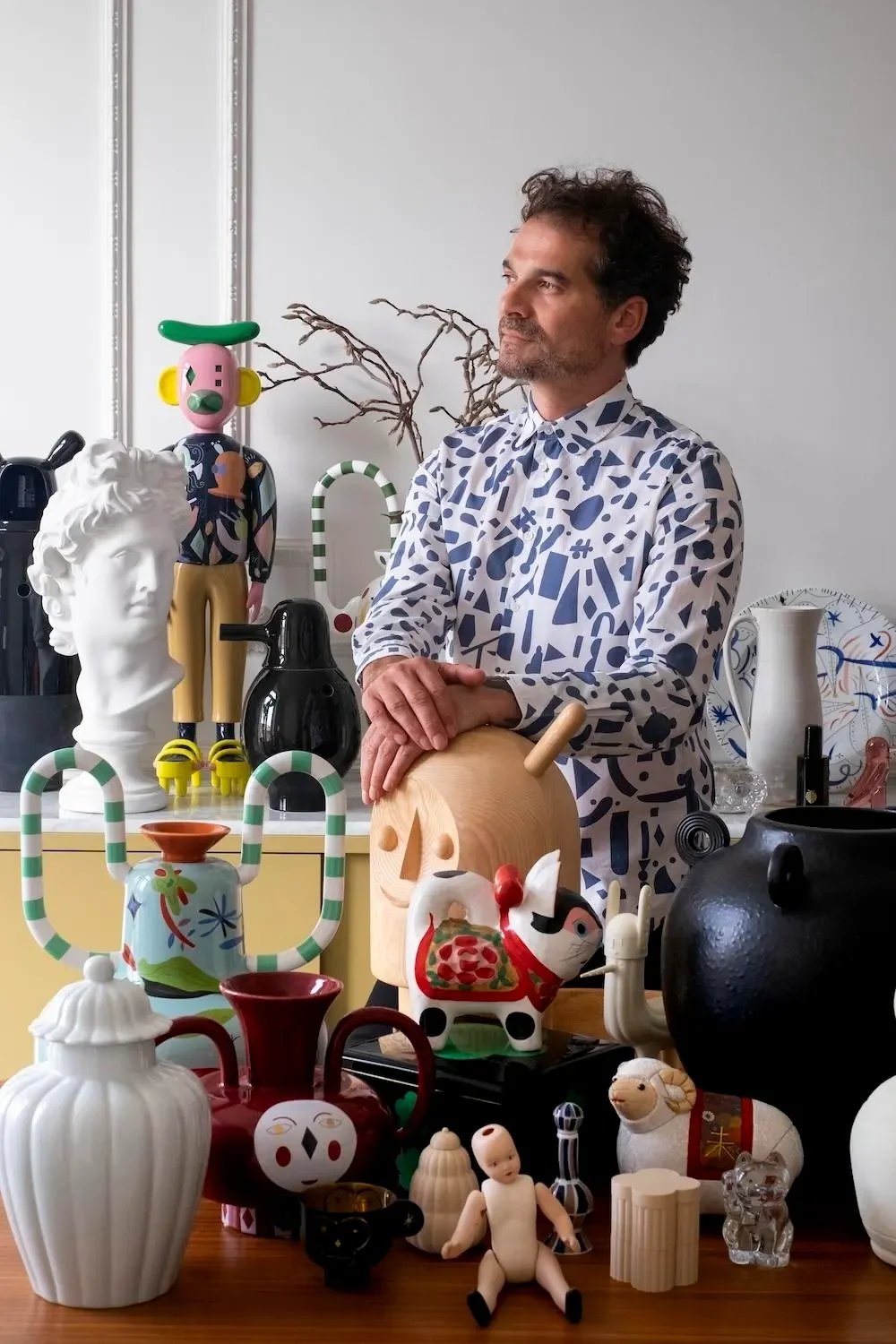
Designer Jaime Hayon among his various design objects at his studio. Photography ©Joseph Fox
With Celebration I, you were given the freedom to create for one of the most prestigious shop windows in London. How did you approach the design?
With all my commissions and collaborations, I tend to be myself. Maybe the client offers a commercial opportunity – as could have been the case here – but that’s not the point for me. There’s nothing commercial about this work. I created an exhibition on the street for everyone to see. I think Fortnum & Mason understood that – they associate with my values: extreme craftsmanship, material exploration, colour, storytelling.
Celebration I looks back on 25 years of studio work while also looking to the future. It’s about everything I love – art, design, craftsmanship – all coming together in a way that I hope will inspire anyone who sees it. There is focused design, free design, playful design; it’s all me, my character. And I love that it’s so public.
Your practice hovers between art and design. How would you describe what you do?
I see myself as both an artist and a designer. In design, I’m not interested in offering a service – I want to make a statement. Yes, our work has to deliver a purpose, but as a studio, we don’t just follow what a client wants. We question things, ask how we can improve a process, and challenge ourselves.
It’s always been about the joy of making. Even if we’ve worked with a material before, we try something new – bronze, crystal, whatever makes sense and pushes us further. I’m personally involved in every piece. It’s a learning process – improving the technique but also seeking the magic. That’s what keeps it exciting after 25 years. It’s the thrill of creating good, true work.
What do you hope people feel when they encounter your work?
I want them to feel something – good or bad, I don’t mind. My work is full of emotion and meaning. I want people to be curious, to feel energy, get excited by the colours, maybe even smile. My work might look cheerful, but there’s weight beneath it – happiness, yes, but also sadness and hard work.
Would you say these emotions reflect your own journey into design?
I started from nothing, working in a bar in Madrid. My parents didn’t have money, and by chance I ended up studying art and design. I couldn’t afford my second year at the Istituto Europeo di Design, so I applied for a grant from the French Institute and continued at the École Nationale Supérieure des Arts Décoratifs in Paris. There, I met incredible people who shaped my career.
It hasn’t always been easy. I’ve met snobby people who didn’t value what they had, but it made me more grateful. I love what I do. This industry is full of amazing creatives and thinkers.
You’ve worked with some of the world’s most respected brands — Fritz Hansen, Baccarat, Cassina, Moooi. Your practice moves through materials and across cultures. Is this important to your process?
Absolutely. Travel, history, ancient civilisations, folklore – they all influence me. I learn through travel. This summer I went to Penang in Malaysia, to Thailand and Laos, visiting temples, exploring layers of culture. In Marrakesh, I immersed myself in the city’s rich, tangled history. It’s always the people, the stories, the passion. That’s what stays with me and informs my work.
Much of your practice engages with the luxury world – a space that’s evolving. How do you navigate it as a designer?
I try to understand what these companies want but keep the collaboration as authentic as possible. You have to be yourself, or they’ll absorb you. For example, with Fortnum & Mason, I could’ve designed something that just displayed my pieces among their merchandise – the standard marketing brief. But that’s not interesting. Many luxury brands try to manipulate reality. Today, luxury is everywhere – too easy, too accessible. It used to be something we had to search for.
There’s a strand of luxury that borders on the grotesque, but also a world of makers rooted in craft. Would you say your ethos aligns with the latter?
Definitely. I work with Cartier because they care about quality and detail. When I collaborate with a crystal house like Baccarat, I know the materials are expensive, so the only way to do it right is to work with people who truly care. And don’t forget – these brands support entire ecosystems of artisans and craftspeople. That’s what makes it worthwhile.
And your thoughts on sustainable design?
I believe sustainability is about making objects that are made to last, and, where possible, using natural materials. I work like this in all my projects, collaborating with local artisans and specialists.
This interview was first published in Forbes